The death of Officer John O’Keefe has become increasingly controversial due to multiple accounts of what happened, inconsistent autopsy findings, and the accusation of a police cover-up. In this dissection, we’re going to look at both sides of the story, the autopsy results, and how his girlfriend’s trial resulted in a hung jury.
High Profile Death Dissection: John O’Keefe
Manner of Death
Undetermined
Cause of Death
Blunt force trauma to the head and hypothermia
Circumstances Surrounding Death:
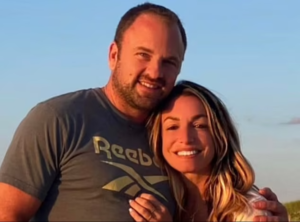
Karen Read and John O’Keefe first met in their 20s and briefly dated after college. Years later, in 2020, John reached out to Karen via Facebook, and the two reconnected.
John & Karen
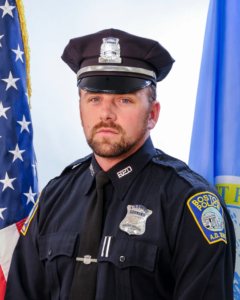
Now in their 40s, Karen was a financial analyst and professor while John was an active officer with the Boston Police Department. In addition to his work, John cared for his young niece (14) and nephew (10) when they became orphans after their mother and father died of natural causes.
January 28, 2022
Karen described John as “the ‘Patron Saint of Canton.’ You’d be hard-pressed to find anyone that didn’t care for John.” Although she referred to him as a “saint,” their relationship was increasingly tumultuous and nearing its breaking point.
9:49 AM
Karen texted John, “You have really hurt me this time” referring to an argument they had that morning. Although John appeared to apologize in the text messages, Karen continued to push the issue and the two discussed the state of their relationship.
At some point in the hours-long conversation, Karen asked John if he was interested in someone else. John told her, “Things haven’t been great between us for awhile. Ever consider that?”
Based on the conversation, it appeared Karen kept calling John although he said he wasn’t available to talk. And by mid-afternoon, Karen told John she was planning to grab a drink and wanted to know if he wanted to meet her later so they could talk.
Around 9:00 PM
John went out for drinks with some of his friends including fellow Boston Police Officer Brian Albert, his wife Nicole, and her sister Jennifer McCabe. Karen met up with the group at C.F. McCarthy’s bar in Canton just as a major snowstorm hit the area.
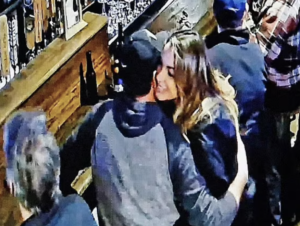
Despite their earlier arguments, friends described they were in good spirits. They were seen on surveillance being affectionate.
Surveillance of John and Karen at C.F. McCarthy’s
11:00 PM
Karen, John, and their friends moved to another bar across the street, Waterfall Bar & Grille.
When the bar closed about an hour later, Brian and Nicole Albert invited everyone back to their house to continue hanging out.
January 29, 2022
12:10 AM
The group exited the bar and John is seen in surveillance carrying a glass from inside the bar. John and Karen headed to her dark Lexus SUV and took off towards the Alberts’ home.
Around 12:15 AM
John texted Jennifer asking her for the Alberts’ address before eventually calling her for more specific instructions.
Shortly after, multiple people in the home claimed they saw a dark SUV pull up to the house. Jennifer McCabe sent John several text messages asking where he was, but none of them were answered.
12:24 AM
John’s phone data places him outside of the Alberts’ home.
12:36 AM
Karen drove the short distance to John’s home and once inside left him a voicemail – “John, I fucking hate you!”
12:59 AM
Karen left John another voicemail – “John, I’m here with your fucking kids and nobody knows where the fuck you are, you fucking pervert.”
1:18 AM
Karen left John a third voicemail – “John, I’m going home. I cannot babysit your niece. You’re fucking using me right now. You’re fucking another girl. You’re a fucking loser. Fuck yourself.”
1:30 AM
Jennifer and some other friends left the Alberts’ home and claimed they didn’t notice anything unusual.
4:53 AM
Karen along with John’s niece called Jennifer saying he didn’t come home and they weren’t able to get in touch with him all night.
5:00 AM
Karen then called John’s friend Kerry Roberts. Kerry claimed Karen shouted “John’s dead!” on the phone. Kerry then picked up Karen and Jennifer to search for him.
6:04 AM
At the Alberts’ home, Kerry, Jennifer, and Karen found John unresponsive and called 911.
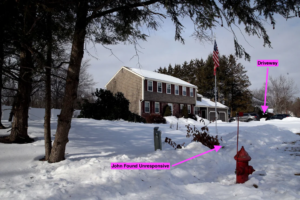
He was lying unresponsive in the snow on the left side of the property between the flagpole and the fire hydrant. In an interview, Karen said, “I couldn’t see his face or his hair, but I knew it was him. I knew it was something that didn’t belong on the lawn.”
This was the opposite side of the property from the driveway where Karen claimed to have last seen him (more on this later).
7:59 AM
John was taken to a local hospital and pronounced dead. He was 46 years old.
February 1, 2022
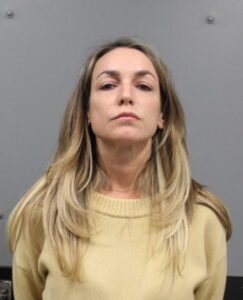
Karen was arrested and charged with manslaughter after being accused of motor vehicle homicide, and leaving the scene of a deadly crash.
Did Karen run over John, leaving him to die, or was she part of an elaborate police cover-up?
Investigation:
Around 6:00 AM on January 29, 2022, John O’Keefe was found unconscious in front of the Alberts’ home by Kerry Roberts, Jennifer McCabe, and Karen Read. He was subsequently pronounced dead at the hospital shortly after.
Friends’ Story
According to John’s friends, they saw a dark SUV, which they assumed was Karen’s car, pull up to the house sometime between 12:15 and 12:30 AM. The car then left and John and Karen didn’t enter the Alberts’ home.
Jennifer continued to text John to see where he was but never got a response. When she left the after-party around 1:30 AM, she said she didn’t notice anything unusual outside.
A few hours later, Karen called Jennifer and was hysterical and when she got in touch with Kerry screamed “John’s dead!” on the phone.
Jennifer McCabe
Then as the three went driving around looking for him, Karen immediately noticed John lying in the snow in front of the Alberts’ home. The friends thought this was strange, almost like Karen knew he was there.
Lastly, when the first responders got there, the friends claimed Karen was inconsolable and screamed “I hit him!”
Karen’s Story
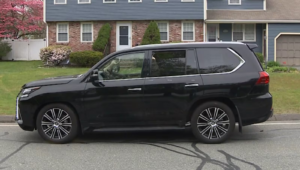
Karen admittedly had been drinking that night but said she felt fine enough to drive. She and John pulled up to the Alberts’ home in her Lexus SUV and parked at the edge of their driveway. Karen told him to go to the house and make sure they were good to go to the party since she didn’t know the Alberts that well.
Karen’s SUV
When Karen saw John reach the front door, she started scrolling on her phone while she waited for him to come back to the car and let her know if it was okay to go in the house.
After a few minutes, John never came back to the car. Karen was pissed because she had to go to the bathroom and didn’t even want to be at their house in the first place.
She then drove the short trip to John’s house and began leaving him angry voicemails.
After a few hours, Karen started to become more concerned because she hadn’t heard from John and the snowstorm was getting worse. She was afraid he might have been hit by a snow plow if he tried to walk home from the Alberts’.
Karen got ahold of Jennifer McCabe and Kerry Roberts who agreed to help her search for John. After a while, they went to the Alberts’ home and she immediately spotted John lying in the snow. Karen said, “I couldn’t see his face or his hair, but I knew it was him. I knew it was something that didn’t belong on the lawn.”
Kerry Roberts
Since John was alive, they alternated doing CPR on him until first responders got to the scene.
When the first responders got there, Karen was in complete distress. She had texted her father that John was dead and that she didn’t want to live. In reference to the “I hit him” comment, Karen argued that she was questioning if she did it, not admitting to it.
Due to Karen’s behavior, she was taken to the hospital and put on a brief psychiatric watch. Less than 2 hours after John was declared dead, Karen’s blood was taken at the hospital. At this time, her BAC was over .09%. A toxicologist later confirmed this would’ve placed her BAC at 0.292% around the time she claimed to have dropped John off.
Arrest
Only days after John’s death, the police’s leading theory was that Karen was drunk driving, struck John while doing a three-point turn, and unknowingly left him there to die.
On February 1, 2022, Karen was arrested and charged with manslaughter after being accused of motor vehicle homicide, and leaving the scene of a deadly crash.
After more information started to come out about that night and their tumultuous relationship, Karen was indicted by a grand jury on June 9, 2022. Her charges were upped to second-degree murder, manslaughter while operating under the influence of alcohol, and leaving the scene of personal injury and death. She was released after posting a $100,000 bond while she awaited trial.
She pleaded not guilty.
Trial:
Months after Karen’s arrest, her defense team was quick to put out a new narrative. They suggested having evidence to prove this whole thing was a mass cover-up by the Canton Police Department and Massachusetts State Police.
They continued with this account in pre-trial hearings suggesting that John was beaten inside the Alberts’ home and had signs of being attacked by a dog. They then suggested they left him outside to die.
The prosecution denied this stating, “Conspiracy theories are not evidence. The idea that multiple police departments, EMTs, Fire personnel, the medical examiner, and the prosecuting agency are joined in, or taken in by, a vast conspiracy should be seen for what it is – completely contrary to the evidence and a desperate attempt to re-assign guilt.”
Despite several attempts to get the case dismissed, Karen’s requests were denied and her trial officially began on April 29, 2024.
Prosecution
By the trial, the prosecution was convinced that Karen intentionally murdered John due to their tumultuous relationship. According to John’s niece and nephew, the couple was fighting a lot and John was planning to end things with Karen.
At the trial, friends recalled their constant fighting and said Karen had jealousy issues. Just weeks before John’s death, they had been on a trip to Aruba and when John hugged a female family friend, Karen lost her mind.
Additionally, Karen was suspected to be cheating with one of John’s friends Brian Higgins. Brian is an ATF agent and often hung out with John. He was even with them on the night of John’s death, although he said he didn’t speak to Karen.
Brian Higgins
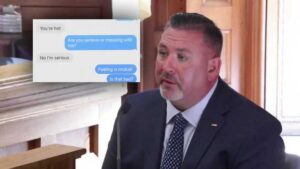
On the stand, Brian Higgins said that Karen had kissed him one night when he was leaving John’s house. She had also been sending him flirty texts for several weeks.
With this in mind, the angry voicemails, and a series of angry texts the morning of, the state argued that Karen was angry, backed her car into him intentionally, and left him to die in the cold.
As far as physical evidence, the prosecution discussed damage on Karen’s car that they believed was consistent with a hit.
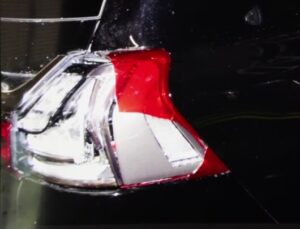
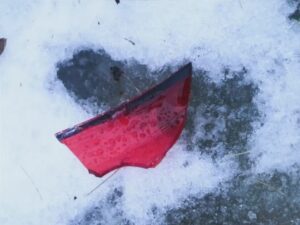
In addition to scratches and some denting, Karen’s passenger-side taillight was broken.
Investigators claimed to have found the missing pieces at the Alberts’ home near where John was located. The pieces were recovered over a few days while they waited for the snow to melt.
Forensically, this piece of evidence didn’t look good for Karen. According to forensic testing, trace evidence of John’s DNA was found on the taillight, and microscopic pieces of the plastic were found in his shirt.
Defense
Although the prosecution seemed to have clear circumstantial and physical evidence, the defense easily poked holes in their story.
First, the prosecution argued that Karen hit John sometime around 12:30 AM and left him out to die. At the trial, a snow plow driver who had gone past the Alberts’ home around 2:45 AM testified that he saw nothing on their front lawn.
Their next crucial piece of evidence was a damning Google search by Jennifer McCabe. The defense argued that in her phone data, they located a Google search at 2:27 AM that read “hos long to die in cold.”
The prosecution argued that she may have opened her internet browser at that time, but did not make that search until Karen asked her to after they discovered John around 6:00 AM. Furthermore, several guests at the party had exchanged multiple phone calls throughout the night. They all claimed it was nothing but butt dials.
One of the biggest red flags in this case was a conflict of interest with the investigators and major mishandling of evidence.
When investigators got to the Alberts’ home, the Alberts did not come outside at any point to see what was going on. Police investigated the outside of their house but did not go in it to confirm there was no evidence. In an unusual move, the Alberts sold their home months after John’s death and “rehomed” their German Shepard despite having her for years. Another weird fact is when the defense took DNA from John’s shirt, they found pig DNA which they believe could be from a dog treat.
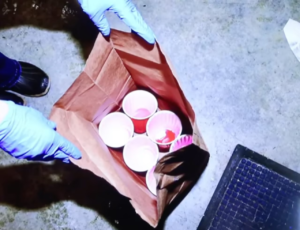
Additionally, blood samples from the scene were collected in red solo cups and transported in paper grocery bags.
Evidence collection
When asked on the stand if this was standard procedure, Canton Police Lt. Paul Gallagher stated, “Nothing about the scene was standard.”
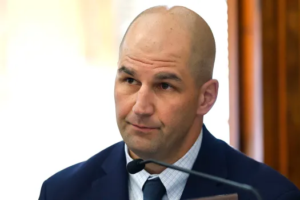
What also broke “standard procedure” was lead detective, Trooper Michael Proctor’s involvement in the case. Michael had known members of the Albert family for years, yet didn’t think this would be a conflict of interest.
Michael Proctor
Due to many issues with documentation and chain of custody in the case, Karen’s defense argued that the police set her up and planted evidence.
When discussing the broken taillight, they said that the plastic couldn’t be broken simply by hitting a human. Their first theory suggested Karen may have cracked, not shattered, the taillight while backing into John’s car that morning. They had security footage from his home to prove she hit his car.
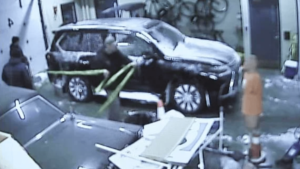
In their second theory, the defense pointed out some issues when the Canton police seized Karen’s car. When the security footage from the police was presented at trial, the defense noted that the video was inverted.
When discussing its importance, Karen’s defense lawyer Alan Jackson said, “The video is inverted, it’s completely inverted. It’s a mirror image, which suggests that the driver side is the passenger side and vice versa but the timestamp across the bottom is not inverted, which means somebody had to put that on – the inverted, the manipulated, the altered video on purpose.”
With this, they believe that the taillight was shattered after the police took the car and they then planted the pieces at the scene.
Even worse, Trooper Michael Proctor had been caught looking for nude photos of Karen on her phone and sending horrific texts about her family, friends, and coworkers. He referred to her as a “whack job,” and said he hoped she’d kill herself.
After the trial, Michael was suspended without pay from the Massachusetts State Police. As of this post, he is currently in the middle of disciplinary hearings.
Mistrial
After 8 weeks of testimony and several days of jury deliberation, the jurors were “deeply divided” and a mistrial was declared.
Her new trial is set to take place on April 1, 2025.
Autopsy:
The autopsy was performed by Dr. Irini Scordi-Bello in the presence of state detectives. In my opinion, I believe this is a conflict of interest, considering that there was some kind of camaraderie between state police officers and the Alberts who lived at the house where his body was found. These state detectives told the medical examiner that John’s death was a result of a hit-and-run and I believe she performed the autopsy only looking with those eyes.
Manner and Cause of Death:
Remember there are 5 manners of death: Natural, Accident, Suicide, Homicide, and Undetermined. Undetermined is used sparingly and as a last resort if the medical examiner feels they can not readily explain and justify how a person died on the witness stand.
In this case, the medical examiner determined that his cause of death was due to blunt force trauma which incapacitated him. He was out in the cold and could not remove himself due to the head injury therefore hypothermia was also listed as a contributing factor.
The ME’s office said the ME “did not have enough info to be able to determine whether those injuries were accidental or not.”
Injuries cause by blunt trauma
Broken ribs
Sternal and rib fractures
Due to the location and knowing that Karen performed CPR on him, this injury is consistent with CPR injury.
Hand bruise
When John was found down in the snow, he was still alive and brought to the hospital. In my opinion, these injuries are consistent with an IV. These are not injuries you would see with self-defense.
Head injury
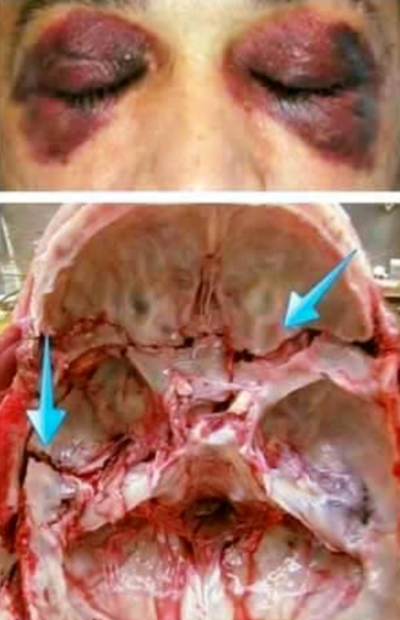
John may appear to have black eye, but what we are looking at here is called periorbital ecchymoses or raccoon eyes.
This is caused by a basilar or base of skull fracture.
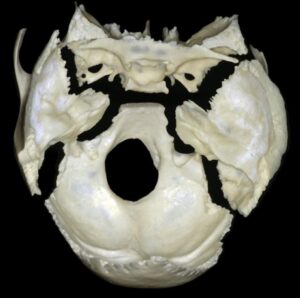
The skull is made up of 22 tiny bones that are all fused together. Where these bones join are called sutures. Normally the skull is hard and rigid, but if it is hit in a certain way, these sutures now become points of weakness. Here is a photo of the unfused bones of the base of the skull and where they can easily break.
Periorbital ecchymoses or raccoon eyes are caused by blood vessels tearing due to the fracture(s) then blood pooling in the tissues surrounding the eyes.
A laceration and abrasion was found on the back of his head. The medical examiner was able to determine this was a blunt head injury, but was not able to identify what caused it. This can be seen in accidental deaths like falls, car accidents, etc. This can also be seen in homicides.
The medical examiner stated that given the skull is “a pretty thick bone” that requires considerable force to break, she suggested O’Keefe suffered “a pretty considerable impact.”
While that is true, keep in mind that Bob Saget died from a basilar skull fracture from hitting his head in a hotel room. It only takes a little force and the right angle.
Arm Injury
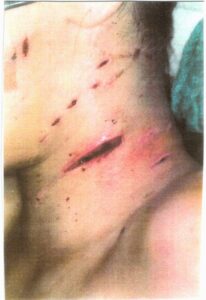
The medical examiner described abrasions or scrapes of various sizes along his right arm. There was no severe bruising or broken bones that would indicate a significant impact caused these described abrasions.
Prosecution: argues these “abrasions” were made from the headlight of Karen’s car. That would make the site of impact around 1 foot (30 cm) in greatest dimension. It is an unusual location for injuries like this to be caused by blunt impact because the arm would bend at the elbow if hit. Furthermore, there is no significant bruising, broken bones, or other signs that would indicate significant blunt trauma.
I disagree that these are abrasions. These are deep depressed wounds.
Defense: argues these wounds were made by a dog bite.
The medical examiner said she did not see any evidence of defense wounds from a person, but could these be defense wounds from a dog? It is not uncommon for victims of a dog attack to have teeth and claw marks on their forearms to try to keep away from a dog’s mouth.
Dog bite wounds have specific patterns that relate directly to the dog’s teeth and pattern of attack.
The injuries are represented by particular “V”-shaped holes and wounds presenting irregular and furrowed borders. The typical “hole-and-a-tear” is a puncture wound (the round hole) produced by the canine tooth of either the maxilla or mandible on one side, which serves as an anchorage point, followed by shaking of the head creating tears enhanced by the victim’s body weight.
Dog bite showing the classic V shaped wound.
This pattern is accompanied by skin abrasions and superficial linear abrasions arranged parallel corresponding to claw marks.
Bite wounds sometimes indicate characteristic tooth marks, whereas claw scratches can indicate paw size. These may enable not only the identification of the species responsible but also the individual animal.
Let’s look at this again. Does anyone else see V-shaped wounds with adjacent parallel lines?
Hypothermia
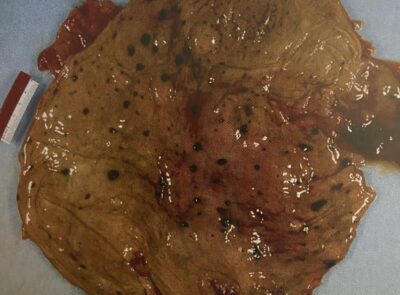
According to the medical examiner, John’s internal organs also indicated possible signs of hypothermia, including small areas of bleeding in his stomach lining and some diffuse hemorrhage of his pancreas and the surrounding tissues.
Some changes can be seen in a body that died from hypothermia which can support this as a cause of death. For example, Wischnevsky’s gastric lesions.
This is when gastric erosions, ulceration, and hemorrhage are seen in the stomach of someone who was found dead in a cold environment.
It is thought these lesions are a response to cold stress. When the body gets cold, the blood vessels throughout the body constrict (especially in the extremities) to try to keep the blood flowing to the organs. These lesions occur when the vessels constrict- restricting blood flow, then open back up- allowing blood flow back.
John O’Keefe was found down and alive in the snow during a blizzard. According to prosecutors, John was knocked over by Karen Read’s car and left for dead around 12:30 AM ish and he wasn’t discovered until 6 AM ish, meaning he was there for around 5 1/2 hours. The temperature in Canton, MA on January 29, 2022 between the hours of 12 AM-6 AM ranged from 18-28°F (-7°C to -2°C). John was found outside, wearing a hoodie, partially covered in snow. He was not dressed appropriately for the weather but Karen Read said it was very common for him not to wear a coat.
When John’s body was discovered, he was brought to the hospital, still alive, and his body temperature was registered in the low 80s°F (26.6 °C).
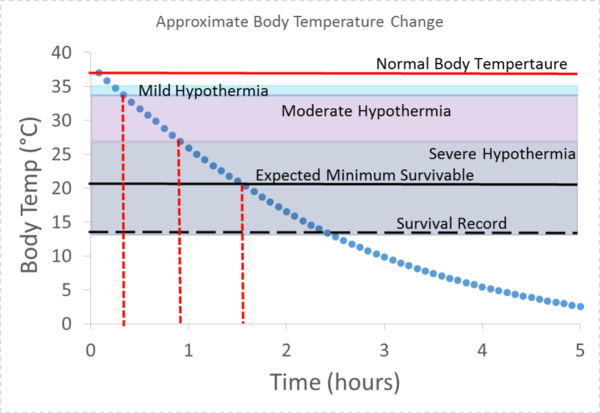
Here is an interesting chart I found on Newton’s Law of cooling in relation to hypothermia. How long does it take for our body temperature to drop?
This chart shows approximate body temperature vs. time for a 176lb (80 kg) person in 25 °F (-3°C) air temperature and 10 mph wind. (Keep in mind John O’keefe weighed approximately 217 lbs (98.4 kg), was in temperatures of 18-28°F (-7°C to -2°C) during an active blizzard with 3+ inches of snowfall.)
According to this chart, a 176-pound person would not survive in these conditions for more than 2.5 hours, so how did John O’Keefe who weighed 217 pounds stay alive for more than double that time period (5.5 hours) in lower temperatures with more extreme weather conditions?
Furthermore, the medical examiner said:
“Alcohol intoxication has been shown to inhibit some of the mechanisms that the body uses to maintain heat, so it’s definitely a factor that is a negative factor when it comes to hypothermia.”
When we are cold, our body’s natural response is to shiver in order to generate heat. Alcohol delays that mechanism. A head injury with unconsciousness also delays that mechanism.
In my opinion, there is no way he was out there for 5.5 hours and still alive when he was found down, not wearing a coat, directly on, and covered by snow.
His temperature read at 80s°F (26.6 °C) at the hospital. According to the chart above, his temperature should have dropped to that degree in only 1-1.5 hours after being outside.
Discussion:
Wow! This case is juicy and it’s not over yet! Karen Reed’s retrial starts on April 1st and we promise to continue the discussion!
I can not help but compare this case to other high profiles we have covered including the death of Ellen Greenberg. Both cases are such hot topics because the initial investigations were handled so poorly they created skepticism with law enforcement and created conspiracy theories.
Forensics should be treated as we treat infectious diseases in the hospital. In the hospital, we use universal precautions which means we treat every patient (dead or alive) as if it is infected with HIV, HEPC, etc., even if they are an 80 year old grandmom. Maybe forensics should treat every case as a homicide until it is proven otherwise. Maybe finding an older guy dead at home in bed from a suspected heart attack may not prompt treating that scene as a crime scene, but certainly, a young (almost dead) cop on another cop’s lawn, bleeding and hypothermic should prompt some sort of investigation!!!
After looking at this evidence extensively, I can not tell you exactly what happened but I can tell you what they are telling us happened is not what happened! The timeline doesn’t match for hypothermia. The wounds don’t match for a pedestrian accident.
If this death scene was fully investigated properly there would not be skepticism, and once you get the internet sleuths involved you are asking for trouble!
What do you think? Are you team prosecution or team defense?
The cop that was put on leave has now been fired by the department. The one who made all those nasty remarks about Karen. I do not believe that Karen killed him. It very much appears to me that those wounds are from a dog.
The Dog attacked him, made him fall and hit his head?
The had him lay down in the house, not realizing how bad he was injured, and when they checked on him later he was nearly dead.
So they set Karen up? Put him outside in the snow. Crazy, but I can’t make it make sense.
Karen was a crazy girlfriend, but I don’t think she did it.
Could the wounds be matched to the Albert’s dog? Could the wounds be from a neighborhood dog, fox, or coyote from when he was laying in the snow…. I think Karen was involved but i don’t think she purposely killed him.. I think they had a fight, she dropped him off and as she was pulling out of the drive way maybe bumped him, he may have fallen due to his inebriated state and icy driveways…maybe stumbled to where he was found.🤷🏻♀️
I honestly don’t know how I feel about this case. Since I wasn’t there, I’ll never know exactly what happened. It just seems very odd to me. I don’t trust Karen and I don’t trust the police dept.
I don’t think either side is telling the whole truth but I don’t think she killed him either, at least on purpose. You don’t purposely run someone over and then drive to their house and leave them a voicemail saying that you f*cking hate them. Even super drunk, if you know that you ran someone over, you wouldn’t make yourself look like more of an asshole just minutes later. Personally I think she dropped him off and he slipped and fell. The girl Jennifer texting him was legit because he hadn’t made it into the house yet. Then the dog bit him and the Alberts freaked out about a lawsuit. They brought him inside and then when they realized he was declining, they took him to the other side of the property closer to the road in the hopes that it would look like a snow plow hit him.
This case breaks my heart. The DA and the people in the house where Officer O’Keefe was found appear to be going out of their way to not allow actual justice for a fallen police officer. I truly hope that the USAO in MA bring those actually responsible for the death of Officer John O’Keefe to justice. Corruption runs deep in MA.
More and more I feel alcohol and drugs play a part in a lot of these crime cases. Seems like they were all inebriated and made poor choices. Those lacerations definitely look like dog bites, I think the dog was the only one not drunk. I’ll be watching this coming April to find out what happens…and I feel so much compassion for those kids he adopted. I hope they are with people who love them.
This happened at town over from where I live and most of us don’t really know where we fall either. However there are lots of “Free Karen Read” protests going on around town. People wear shirts and bumper stickers everywhere.
Thank you for your perspective. This is such an interesting point of view. I appreciate that you followed the physical evidence which is the only evidence that we can truly honor in court cases. I was a juror recently and how we feel about the people involved shouldn’t taint the information we are being relayed. I hope that the hatred for this woman can be removed from the hard facts of the case for a fair trial.
A few details are off but this is the gist.
Defense all the way!!
Linnéa Håkansson
February 15, 2025 at 5:32 amLog in to Reply
I don’t know what happened obviously (along with everyone else) but I definitely don’t think that Karen Reed should be convicted of his death! There are too many questions unanswered, not enough evidence that points to her or backs the prosecution’s claims, there are other plausible scenarios and there’s plenty of reasonable doubt! I hope that she’s acquitted, if she isn’t then I would feel that there’s something wrong with the judicial system in the us.
This is a tough one! Because both parties seem guilty AF! But! Even though Karen is the crazy girlfriend, there are too many inconsistencies with the Alberts. If they weren’t guilty, why move and rehome your dog? Why didn’t the police investigate inside the house? Too many questions surrounding the Alberts.
Whatever you do – do NOT go to Canton….the “McAlberts” are as shady as they come. Team defense for sure. Even the judge in this case is so completely biased that we will never ever really know what actually happened. There will never be justice for John.
Lastly, I’ve never hit my husband with my car or anything like that – but some of the texts I send him when I’m in a “mood” for lack of a better term WOOF – I should be in prison 15 times over!!! LOL So I really hope people are not gonna use Karen’s texts to support the evidence, that’s just awful.
TEAM DEFENCE!! You should be on team defense if there’s any reasonable doubt whatsoever. We have changed how the justice system works in this country, and now, people are presumed guilty until proven innocent. I think there is plenty of reasonable doif there’s any reasonable doubt whatsoever, you should be team defense we have changed how the justice system works in this country and now people are presumed guilty until proven innocent. I think there is plenty of reasonable doubt in this case. but in this case.
Karen Read is not guilty of this death in the way the state claims. I do not believe she’s guilty in anyway otherwise either. Definitely dog bites and was hit with something very strong (bat/thick liquor bottle) in the back of the head.










Team Prosecution!!👮🏻♂️
But… why??
Those marks are compelling for the defense.
Defense 💯
The cop that was put on leave has now been fired by the department. The one who made all those nasty remarks about Karen. I do not believe that Karen killed him. It very much appears to me that those wounds are from a dog.
The Dog attacked him, made him fall and hit his head?
The had him lay down in the house, not realizing how bad he was injured, and when they checked on him later he was nearly dead.
So they set Karen up? Put him outside in the snow. Crazy, but I can’t make it make sense.
Karen was a crazy girlfriend, but I don’t think she did it.
Defense
Team Defense.
Could the wounds be matched to the Albert’s dog? Could the wounds be from a neighborhood dog, fox, or coyote from when he was laying in the snow…. I think Karen was involved but i don’t think she purposely killed him.. I think they had a fight, she dropped him off and as she was pulling out of the drive way maybe bumped him, he may have fallen due to his inebriated state and icy driveways…maybe stumbled to where he was found.🤷🏻♀️
I honestly don’t know how I feel about this case. Since I wasn’t there, I’ll never know exactly what happened. It just seems very odd to me. I don’t trust Karen and I don’t trust the police dept.
That’s pretty much where I’m at!
Defense absolutely
Team defense. The dateline episode was very enlightening
I don’t think either side is telling the whole truth but I don’t think she killed him either, at least on purpose. You don’t purposely run someone over and then drive to their house and leave them a voicemail saying that you f*cking hate them. Even super drunk, if you know that you ran someone over, you wouldn’t make yourself look like more of an asshole just minutes later. Personally I think she dropped him off and he slipped and fell. The girl Jennifer texting him was legit because he hadn’t made it into the house yet. Then the dog bit him and the Alberts freaked out about a lawsuit. They brought him inside and then when they realized he was declining, they took him to the other side of the property closer to the road in the hopes that it would look like a snow plow hit him.
I think I need to watch it. I didn’t realize half of that stuff happened. Guess I read too fast. 🤔
She clearly hit him, or she wouldn’t have googled it.
She didn’t. His “friend” did.
This case breaks my heart. The DA and the people in the house where Officer O’Keefe was found appear to be going out of their way to not allow actual justice for a fallen police officer. I truly hope that the USAO in MA bring those actually responsible for the death of Officer John O’Keefe to justice. Corruption runs deep in MA.
More and more I feel alcohol and drugs play a part in a lot of these crime cases. Seems like they were all inebriated and made poor choices. Those lacerations definitely look like dog bites, I think the dog was the only one not drunk. I’ll be watching this coming April to find out what happens…and I feel so much compassion for those kids he adopted. I hope they are with people who love them.
Dog bites and dog scratches and then they rehomed the dog? Come on, now.
This happened at town over from where I live and most of us don’t really know where we fall either. However there are lots of “Free Karen Read” protests going on around town. People wear shirts and bumper stickers everywhere.
Thanks for the dissection and discussion. Defense 100%
Thank you for your perspective. This is such an interesting point of view. I appreciate that you followed the physical evidence which is the only evidence that we can truly honor in court cases. I was a juror recently and how we feel about the people involved shouldn’t taint the information we are being relayed. I hope that the hatred for this woman can be removed from the hard facts of the case for a fair trial.
Is anyone else confused why they did cpr on him if he was alive?
Reasonable doubt equals an acquittal
Team defense.
A few details are off but this is the gist.
Defense all the way!!
I don’t know what happened obviously (along with everyone else) but I definitely don’t think that Karen Reed should be convicted of his death! There are too many questions unanswered, not enough evidence that points to her or backs the prosecution’s claims, there are other plausible scenarios and there’s plenty of reasonable doubt! I hope that she’s acquitted, if she isn’t then I would feel that there’s something wrong with the judicial system in the us.
This is a tough one! Because both parties seem guilty AF! But! Even though Karen is the crazy girlfriend, there are too many inconsistencies with the Alberts. If they weren’t guilty, why move and rehome your dog? Why didn’t the police investigate inside the house? Too many questions surrounding the Alberts.
Whatever you do – do NOT go to Canton….the “McAlberts” are as shady as they come. Team defense for sure. Even the judge in this case is so completely biased that we will never ever really know what actually happened. There will never be justice for John.
Lastly, I’ve never hit my husband with my car or anything like that – but some of the texts I send him when I’m in a “mood” for lack of a better term WOOF – I should be in prison 15 times over!!! LOL So I really hope people are not gonna use Karen’s texts to support the evidence, that’s just awful.
TEAM DEFENCE!! You should be on team defense if there’s any reasonable doubt whatsoever. We have changed how the justice system works in this country, and now, people are presumed guilty until proven innocent. I think there is plenty of reasonable doif there’s any reasonable doubt whatsoever, you should be team defense we have changed how the justice system works in this country and now people are presumed guilty until proven innocent. I think there is plenty of reasonable doubt in this case. but in this case.
Karen Read is not guilty of this death in the way the state claims. I do not believe she’s guilty in anyway otherwise either. Definitely dog bites and was hit with something very strong (bat/thick liquor bottle) in the back of the head.